
The Hidden Cost of Low Translation Rates: An Industry Reality
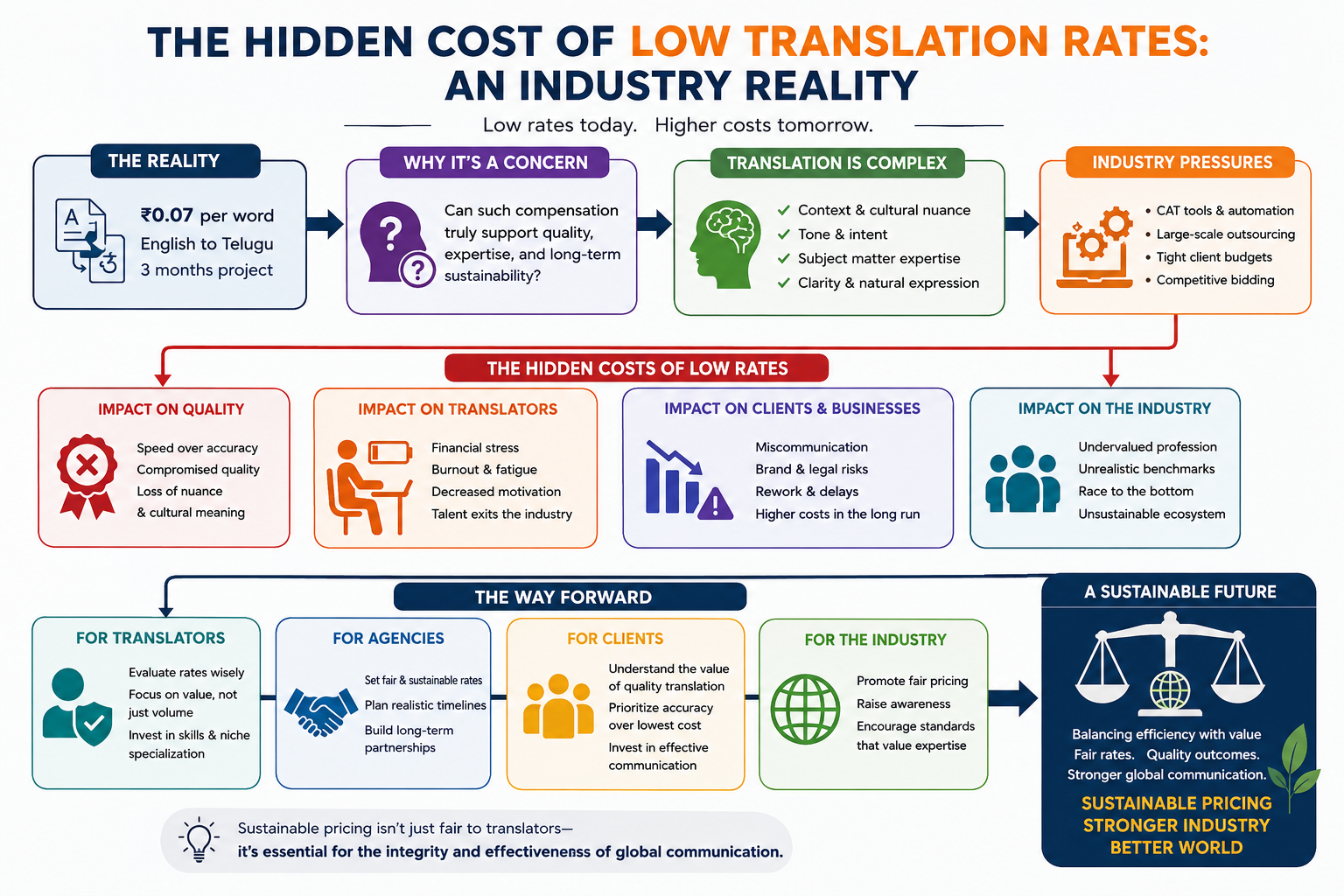
The translation industry is evolving rapidly, driven by globalization and the growing demand for multilingual content. However, this growth is not always benefiting the professionals at its core. A troubling trend is emerging—declining rates that challenge the sustainability of freelance translators.
In my own experience, I was recently offered ₹0.07 per word for an English-to-Telugu project spanning three months. At first glance, the promise of steady, high-volume work seemed appealing. However, the rate itself raised a critical question: can such compensation truly support quality, expertise, and long-term sustainability? In many professional contexts, translation rates are significantly higher depending on specialization and subject matter, making ultra-low offers difficult to sustain without compromising quality.
Translation is far more than a simple exchange of words. It requires a deep understanding of context, cultural nuance, tone, and subject matter. For language pairs like English and Telugu, where clarity and natural expression are essential, the translator’s role becomes even more demanding. Rates that fail to reflect this complexity risk undervaluing not just the work, but the profession itself.
The increasing use of Computer-Assisted Translation (CAT) tools and the rise of large-scale outsourcing have intensified price competition. From an agency perspective, tight client budgets and competitive bidding often drive such pricing decisions. However, while these tools improve efficiency, they have also contributed to downward pressure on pricing, as volume and speed are increasingly prioritized.
This experience is not an isolated case but part of a broader industry pattern. The expansion of global freelance marketplaces has increased competition, particularly in regional language pairs, leading to more aggressive pricing strategies. Pricing pressures are steadily redefining translation as a low-cost service rather than a skilled profession. When compensation falls below sustainable levels, it impacts not only freelancers but also businesses that rely on accurate and culturally appropriate communication.
At extremely low rates, maintaining high standards becomes difficult, and translators may be forced to prioritize speed over accuracy. Industry discussions consistently suggest that lower pricing can affect overall quality, especially in work requiring cultural and contextual precision.
For translators, such offers demand careful evaluation. Accepting low rates may provide short-term work but can undermine long-term career growth and professional standards. For agencies and clients, the message is equally important: quality translation cannot exist without fair compensation. Greater transparency in pricing, realistic timelines, and a shared commitment to quality can help bridge the gap between cost and value.
The future of the translation industry depends on maintaining a balance between efficiency and value. Sustainable pricing is not just about fairness to translators—it is essential for preserving the integrity and effectiveness of global communication.
Ashok Kumar Filix is an English–Telugu translator specializing in high-volume localization projects. With practical experience in handling bulk assignments, he brings insight into pricing dynamics, quality standards, and the impact of market trends on freelance translators. His writing explores the intersection of language, technology, and professional sustainability.