
CITLoB Localization's Professional Desk - AI Can Translate. But Can It Localize?
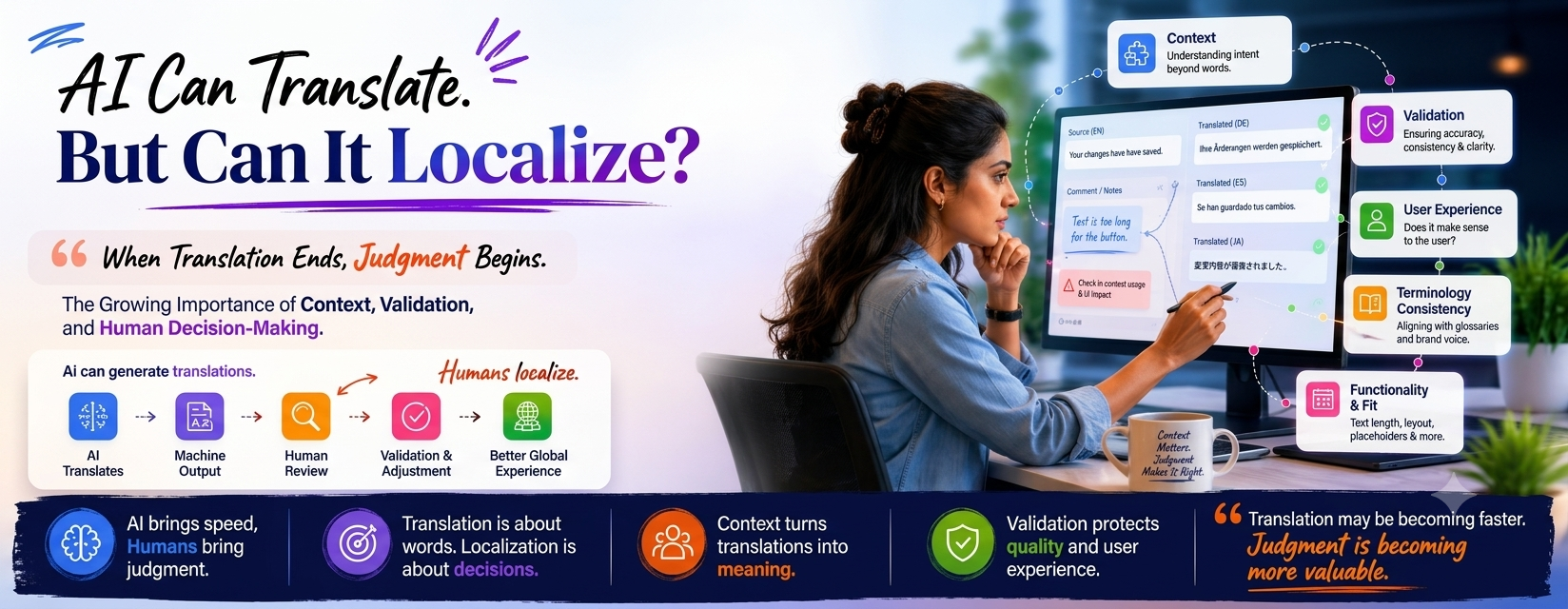
When Translation Ends, Judgment Begins: The Growing Importance of Context, Validation, and Human Decision-Making
The localization industry is having a lot of conversations about speed.
How quickly can we translate? How much content can AI process? How fast can we launch products globally?
These are important questions. But they may not be the most important ones.
The real challenge often begins after the translation is generated.
Today, AI can produce translations in seconds. What it cannot fully understand is why a piece of text exists, where it appears, how it functions within a product, or what experience it creates for the user.
A translated string may be linguistically correct and still be wrong.
It might fit the glossary but not the interface. It might match the source text but not the user's expectations. It might be accurate in isolation but confusing in context.
This is where localization becomes more than language. It becomes judgment.
Every release involves decisions that cannot be solved by translation alone: Does this term make sense in the product? Will users understand it? Is the context clear? Should consistency or usability take priority?
As AI continues to accelerate translation workflows, the value of localization professionals is shifting.
Our role is no longer defined only by the ability to translate content. Increasingly, it is defined by the ability to evaluate, validate, and make decisions that protect the user experience across languages.
Translation may be becoming faster.
Judgment is becoming more valuable.
Regards,
Roshi Mehta
Localization Professionals