
Beyond Our Own Corner: Why the Localisation Industry Needs Cross-Sector Thinking
Industries often look within themselves for answers. They learn from familiar competitors, follow sector-specific trends and seek solutions from people who understand their business. While this approach builds expertise, it can also limit the perspectives organisations bring to the challenges they face.
For the localisation industry, looking beyond familiar boundaries presents a valuable opportunity.
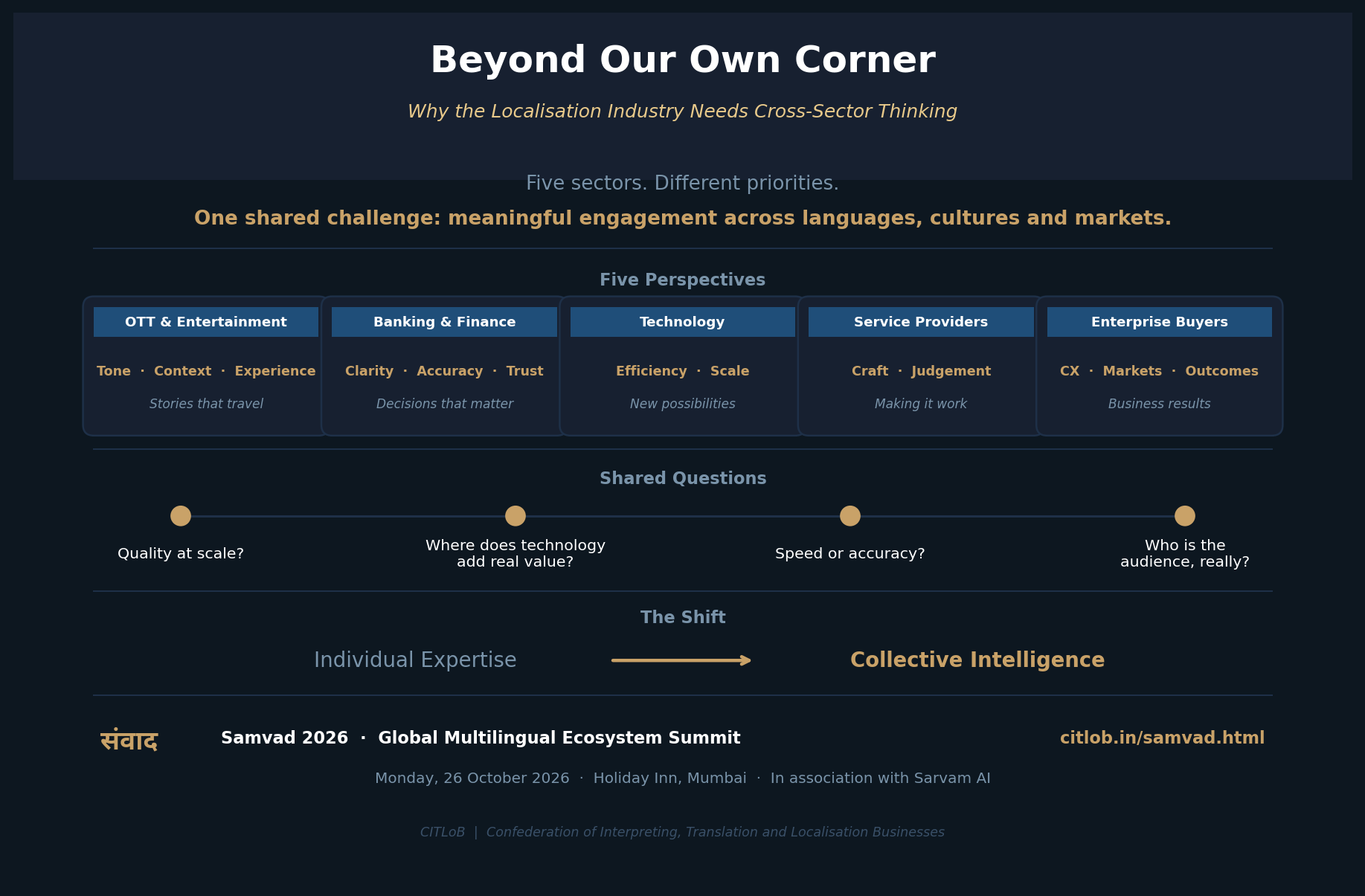
The ecosystem brings together diverse stakeholders, from OTT platforms and financial institutions to technology developers, language service providers and enterprise buyers. Each operates with different priorities, yet all share a common challenge: enabling meaningful engagement across languages, cultures and markets.
What might happen if these different perspectives informed one another more often?
Different Industries, Shared Challenges
Consider the OTT and entertainment sector, where localisation helps stories travel across linguistic and cultural boundaries. Success depends not merely on translating dialogue, but on preserving tone, context and the experience that allows content to resonate with audiences.
In banking and financial services, the priorities are different. Clarity, accuracy, consistency and trust are essential to multilingual communication, particularly when people are making important financial decisions.
Enterprise buyers approach localisation through yet another lens, considering customer experience, market expansion, operational efficiency and business outcomes. Language service providers must translate these expectations into practical workflows, quality standards and delivery models, while technology companies explore ways to improve efficiency and scalability.
Despite these differences, common questions emerge. How can quality be maintained at scale? Where can technology create genuine value? How should organisations balance speed with accuracy? And how can multilingual experiences better serve their intended audiences?
Exploring these questions across sectors can reveal ideas that might otherwise remain confined to individual domains.
The Value of a Different Perspective
Cross-sector learning is not about copying another industry's practices. It is about understanding the thinking behind them and identifying where those principles might prove useful elsewhere.
OTT's focus on audience engagement, for example, may offer insights into designing better multilingual customer experiences. The emphasis on accuracy in financial services can inform approaches to linguistic quality and risk management. Technology providers can introduce new possibilities for automation, while language service providers contribute practical expertise in cultural adaptation, contextual understanding and human judgement.
The relationship between buyers and service providers offers another important lesson.
Buyers understand their markets, customers and commercial objectives. Service providers understand the linguistic and operational complexities of delivering multilingual solutions. When these perspectives are exchanged early, localisation can become a strategic consideration rather than a task addressed only after broader business decisions have been made.
The value lies not simply in sharing information, but in developing a more complete understanding of the problem.
From Individual Expertise to Collective Intelligence
Specialisation remains essential, but expertise becomes more powerful when supported by an understanding of the wider ecosystem.
As AI reshapes workflows and businesses respond to evolving customer expectations, no single stakeholder has a complete view of the opportunities and challenges ahead. Technology capabilities, commercial priorities, linguistic considerations and user needs increasingly intersect.
This makes the ability to learn across professional boundaries an important organisational capability.
It requires curiosity, a willingness to question familiar assumptions and the recognition that valuable insights can emerge from people whose work differs from our own.
Industry conversations can help create the conditions for this learning. When technology developers, buyers, language professionals and service providers exchange perspectives, they can examine shared challenges from different vantage points and identify opportunities for more informed decisions and stronger collaboration.
The significance of these exchanges lies not only in the conversations themselves, but also in what participants take back to their organisations: a new way of approaching a problem, a clearer understanding of another stakeholder's priorities, or an idea that improves how they work.
Looking Beyond Our Own Specialisation
The localisation industry will continue to depend on deep expertise. But its ability to evolve will also depend on how effectively its different segments learn from one another.
OTT platforms, financial institutions, technology companies, service providers and enterprise buyers may approach localisation from different directions, yet their experiences can collectively strengthen the ecosystem.
Sometimes, the most useful answer to a familiar challenge does not come from someone solving the same problem in the same way. It comes from someone who sees the problem differently.
For a connected multilingual ecosystem, learning to recognise and act on these connections may be one of its most valuable competitive advantages.
Continuing the Conversation
Samvād 2026, CITLoB's Global Multilingual Ecosystem Summit, brings together perspectives from across the industry in association with Sarvam AI.
Join us on Monday, 26 October 2026 at Holiday Inn, Mumbai.