
AI, Translation and the Road Ahead: Are We Looking at the Right Opportunities?
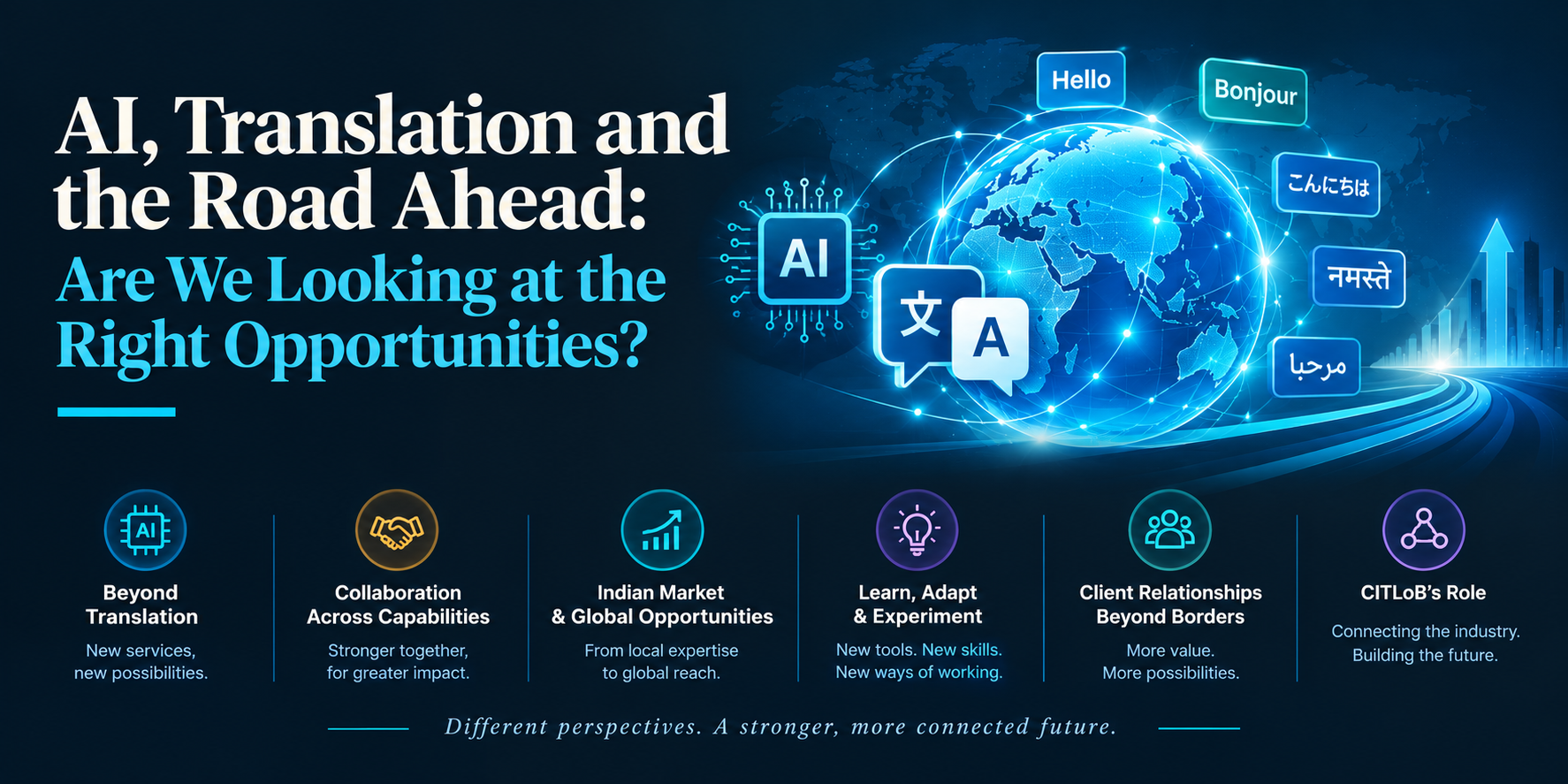
Over the last few months, whenever I meet friends from the localization industry, one common topic that comes up is AI and its impact on our business.
Many of us are already seeing the changes. Translation volumes are reducing, clients are asking for lower rates, and in some cases, customers are using AI tools themselves instead of sending work to translation companies.
For freelancers and SMEs like us, this is obviously a concern. After all, many of us have built our businesses over several years, developed relationships with clients, and invested in resources, tools, and capabilities. And suddenly, the way the business operates seems to be changing. I had read a quote somewhere along the lines of, “When I knew life’s answers, they changed the questions.” It feels quite relevant to the times we are living in.
I have been associated with the Japan–India markets for over 20 years and with the localization business for several years now. We have seen changes earlier too, with CAT tools, MT, cloud-based translation platforms, and more. But I think the current AI wave is different, both in terms of speed and the impact it can have.
So, Where Do We Go from Here?
One thing I feel is that we should not look at AI only as a threat to our existing translation business. Of course, some part of traditional work will reduce, and I don't think we can avoid that. But at the same time, AI is also creating a lot more multilingual content than before.
Earlier, a company might have translated only its website and a few product manuals due to budget limitations. Today, with AI, the same company can think of making its training videos, customer support materials, product information, and other content available in multiple languages.
But does that mean all this content is ready for actual use? Not necessarily. Someone still needs to check the quality, terminology, cultural aspects, and whether the content makes sense to the end user. This is especially important in markets like Japan, where expectations around quality and customer experience are quite high. This is where I think our industry has an opportunity.
Can We Look Beyond Translation? Collaboration Across Diverse Skill Sets and Capabilities
For example, a freelance linguist who has been doing Japanese translation for several years could also get involved in testing Japanese software interfaces, checking AI-generated responses, validating chatbot conversations, or reviewing training content. Similarly, a small LSP could start offering multilingual testing, subtitling, AI content evaluation, or even L1 customer support in different languages.
These may not be completely new services. Some companies are already doing them. But perhaps we have not looked at them seriously enough as an extension of our existing business.
Another area I feel we should explore is collaboration.
In India, we have hundreds of freelancers, SME firms, and technology service providers. Each has certain strengths, but individually, we may not have all the capabilities that customers are looking for.
A language company may not have software testing capabilities. An IT company may not have Japanese or German language resources. Why not work together and offer a combined, end-to-end service?
We don't necessarily need to invest heavily or hire large teams to start something new. While this is easier said than done, like-minded people can certainly put together a framework through the right processes, partnerships, and contractual arrangements.
What About the Indian Market Itself?
Another interesting development is the number of Indian companies looking at international markets. SaaS companies, manufacturing companies, startups, and even smaller businesses are exploring Japan, Europe, the Middle East, and other geographies.
Many of these companies may not have large translation requirements. But they certainly need assistance with multilingual websites, product localization, customer communications, training materials, and sometimes even local-language support. I feel this is an opportunity that we, as an Indian language industry, could explore more actively.
Of course, none of this is going to happen automatically.
We will have to learn new tools, understand new customer requirements, and probably change the way we price and deliver our services. Some experiments may work, while others may not. But continuing with exactly the same services and expecting the same business volumes or rates may not be a practical option either.
Perhaps each of us can start small. Identify one additional service that we can offer our existing clients. Learn one new AI tool. Partner with another company that has complementary capabilities. Or approach a completely different customer segment.
The Next Few Years: Challenging, but Full of Possibilities
I feel the next few years will be challenging, but also interesting for our industry.
We have spent years building language skills, domain knowledge, customer relationships, and an understanding of different cultures. These are valuable assets, and AI does not make all of them irrelevant overnight.
The question is how we can use these strengths in a changing market.
Rather than looking only at how AI is reducing our traditional translation business, perhaps we should also spend some time discussing what new businesses we can create around it.
Can we assist foreign companies in setting up GCCs? Can we help clients with business travel and add a tourism element to the services we provide?
You might not believe this, but one of my Japanese clients used to ask me to book his air tickets to India. Earlier, I would tell him, “I am not a travel agent; I will introduce you to one.” But he would say, “You know me and my preferences. Add 5% to the cost and bill us.”
He was a chain-smoker, and I would always book his tickets via Thailand, Malaysia, or Hong Kong, as these routes involved a three-to-four-hour flight from Narita. He would literally run off the plane to have a smoke!
The point here is that our client relationships and know-how can certainly be leveraged, perhaps not always in the traditional sense, but in different ways that continue to create value from the client's perspective.
And I think organizations like CITLoB play an important role here by bringing freelancers, LSPs, MLVs, and technology firms together to exchange ideas, explore partnerships, and learn from one another's experiences.
After all, most of us are facing similar challenges. Perhaps some of the solutions can also come from within our own community.
Regards,
Sunil Kulkarni,
Founder Member - CITLoB